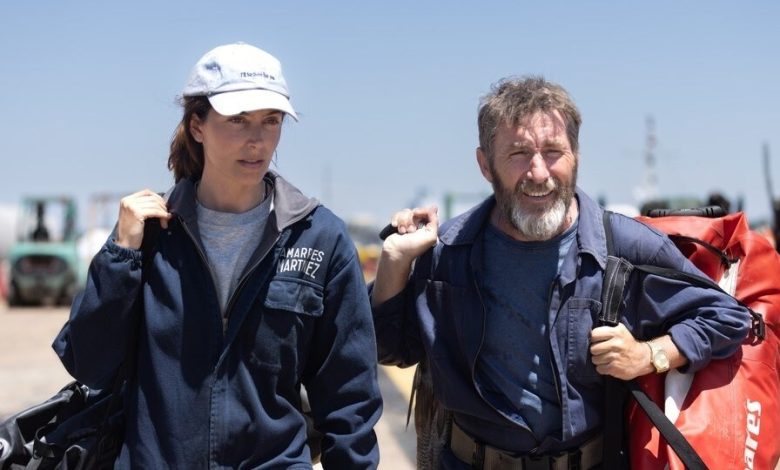
Los Tigres: A Suffocating Thriller Hidden in the Depths of Huelva
- Category: Thriller, Drama, Crime
- Release Date: 2025 (Festival Circuit/Theatrical)
- Cast: Antonio de la Torre, Bárbara Lennie, Joaquín Núñez, Jesús del Moral
- Language: Spanish (English Subtitles Available)
- Duration: 1h 49m
- Director: Alberto Rodríguez
There are few filmmakers in Europe who capture the texture of a place quite like Alberto Rodríguez. With masterpieces like Marshland (La Isla Mínima) and Unit 7 (Grupo 7), he defined the genre of “Andalusian Noir”—stories steeped in the heat, dust, and moral ambiguity of Southern Spain. With his latest film, Los Tigres (2025), Rodríguez trades the marshes and the prisons for the murky, industrial waters of the Huelva coast.
Reuniting with his longtime co-writer Rafael Cobos, Rodríguez delivers a taut, claustrophobic thriller that feels like a spiritual successor to classic blue-collar crime dramas. Starring the heavyweights of Spanish cinema, Antonio de la Torre and Bárbara Lennie, Los Tigres is not an action movie about drug lords; it is a desperate story about ordinary people holding their breath to survive. For the audience on fmovies.tr, this film serves as a masterclass in tension, proving that the scariest monsters aren’t sharks, but the choices we make when our backs are against the wall.
The Plot: Buried Treasure in a Rust Bucket
The narrative immerses us immediately into the precarious lives of siblings Antonio (Antonio de la Torre) and Estrella (Bárbara Lennie). They are not recreational divers exploring coral reefs; they are industrial workers. Antonio is a helmet diver, fixing hulls and welding pipes in the dark, polluted waters of the port of Huelva. It is dangerous, unglamorous work. Estrella, his sister, is a marine biologist by training but serves as his tender and assistant, her dreams of studying underwater life suffocated by the economic reality of their family.
Their financial situation is dire. They are “The Tigers,” a nickname perhaps mocking their fierce struggle to stay afloat in an economy that has left them behind. The inciting incident is classic noir: during a routine inspection of a massive merchant ship anchored in the bay, Antonio discovers something attached to the hull. It isn’t a mechanical fault; it is a “torpedo”—a parasitic container used by cartels to smuggle cocaine across the Atlantic without the crew’s knowledge.
The Moral Decompression
The discovery presents a terrifying dilemma. Do they report it to the Guardia Civil and risk losing their contracts due to the ensuing investigation? Or do they try to capitalize on it? The cocaine represents more money than they could earn in ten lifetimes of scrubbing barnacles. Driven by debt and the hopelessness of their routine, they make the fatal decision to intervene.
However, stealing from a cartel is not as simple as cutting a rope. The film chronicles the excruciating unraveling of their lives as they try to offload the merchandise. They are dragged into the orbit of local criminals, including the menacing Gordo (Joaquín Núñez), and soon realize that the pressure underwater is nothing compared to the pressure on the surface.
Director’s Vision: Alberto Rodríguez’s Industrial Grit
Alberto Rodríguez has always been fascinated by systems of power and the little people crushed beneath them. In Los Tigres, he turns the port of Huelva into a character of its own. It is a landscape of rusty cranes, oil slicks, and gray skies. There is no glamour here. The cinematography is tactile; you can almost smell the diesel fumes and the salt.
The underwater sequences are directed with suffocating realism. Unlike Hollywood movies where the water is crystal clear, here it is dark, green, and turbid. The sound design is pivotal—the rhythmic hiss-clack of the breathing regulator becomes the soundtrack of Antonio’s anxiety. Rodríguez uses the diving suit as a metaphor for isolation. When Antonio is down there, he is cut off from the world, hearing only his own breathing and Estrella’s distorted voice over the comms. It creates a level of suspense that is purely psychological.
The Cast: A Duet of Desperation
The film rests entirely on the relationship between the two leads, and the casting is impeccable.
- Antonio de la Torre as Antonio: De la Torre is arguably Spain’s greatest living actor. He specializes in playing men who are emotionally repressed and physically exhausted. As Antonio, he carries the weight of the world on his shoulders. He is protective of his sister but also resentful of their shared poverty. His performance is physical; you see the toll the diving takes on his body, the way he moves with a permanent ache.
- Bárbara Lennie as Estrella: Lennie matches De la Torre beat for beat. Estrella is the brains of the operation, but she is also the moral compass that begins to spin wildly. Lennie portrays her frustration beautifully—she is a woman of science forced to become a criminal. The sibling chemistry is raw and believable; they bicker, they protect each other, and they drag each other down.
- Joaquín Núñez as Gordo: Returning to work with Rodríguez (after Unit 7), Núñez plays the local antagonist with a terrifying mix of joviality and violence. He represents the banality of evil in this grim ecosystem.
Critical Review: The Bends of Morality
Los Tigres is a film about consequences. It fits into the tradition of films like A Simple Plan or The Treasure of the Sierra Madre, where finding wealth is the worst thing that can happen to a person.
Social Commentary
Beyond the thriller elements, the script by Rafael Cobos and Rodríguez offers a biting critique of the Spanish economy. The “precarious economy” mentioned in the synopsis is the true villain. Antonio and Estrella are skilled, hardworking professionals, yet they cannot make ends meet. The film asks: How far would a decent person go when society breaks its promise to them? The drug trade is shown not as a glamorous lifestyle, but as a parasitic industry that preys on the desperation of the working class.
Pacing and Atmosphere
The film runs for 1 hour and 49 minutes, and the pacing is deliberate. It is a slow burn. The tension builds incrementally, like nitrogen bubbles in the blood. The first half focuses on the logistics of the theft—the technical details of diving, the maps, the timing. This procedural approach makes the second half, where everything goes wrong, feel incredibly grounded. We understand exactly what is at stake because we saw how hard they worked to set it up.
Los Tigres is a triumph of Spanish noir. It is gritty, intelligent, and relentlessly tense. Alberto Rodríguez proves once again that he is a master of atmosphere. The underwater scenes are some of the best filmed in recent years, not for their spectacle, but for their terror.
For fans of high-stakes drama and realistic thrillers, this is a must-watch. It doesn’t offer easy answers or Hollywood endings. It leaves you gasping for air, reminding us that in the deep end of the crime world, no one can hear you scream. Antonio de la Torre and Bárbara Lennie deliver powerhouse performances that will likely sweep the Goya Awards in 2026.